Spec Obsession Diary, Vol. 1: What the Numbers on 2026 Supersports Really Reveal
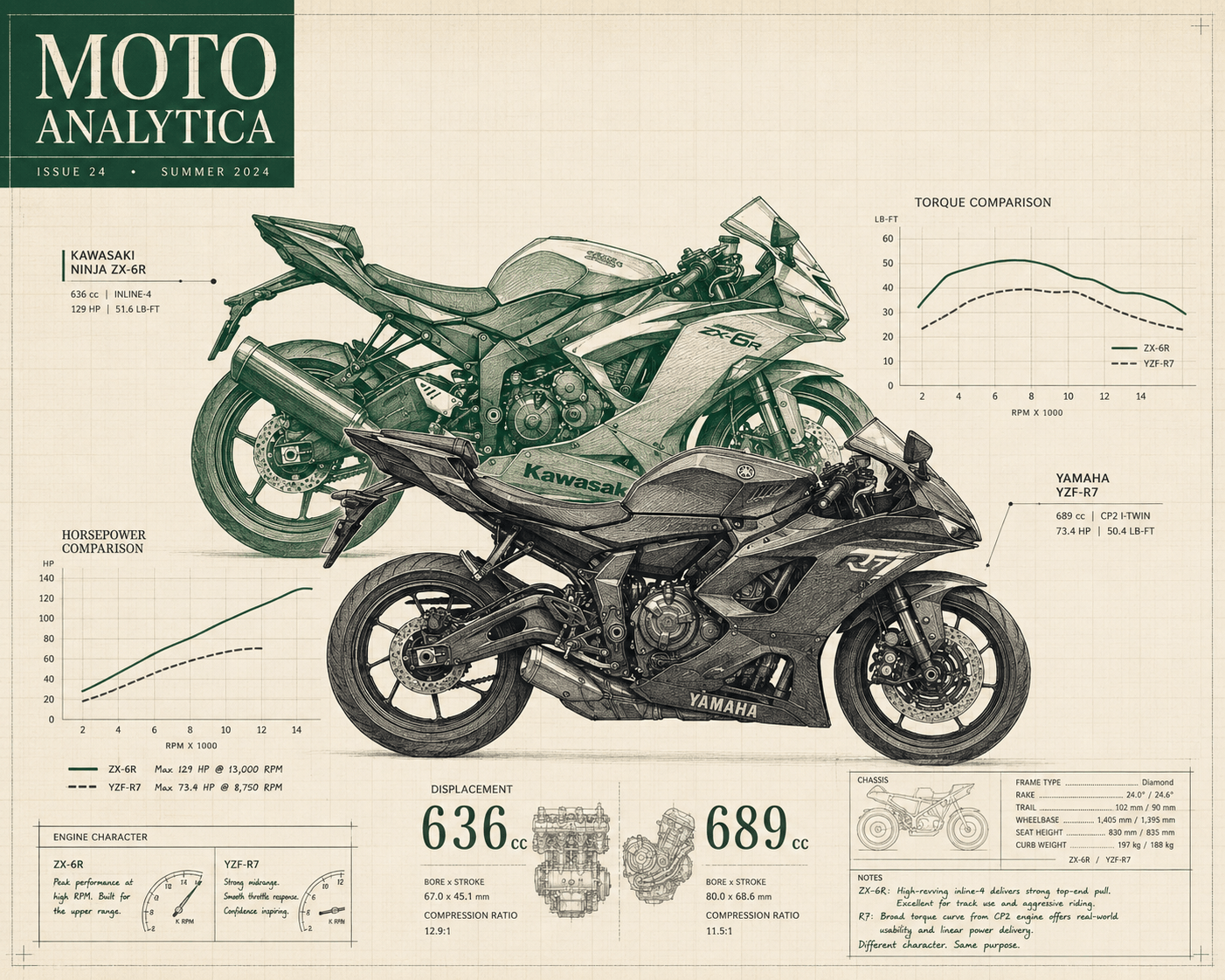
On paper, 2026 model-year supersports look nearly identical in spec — but the design philosophy behind each one couldn't be more different. In this inaugural column, a former test engineer reads between the lines of the spec sheet to dissect what the numbers really say.
KEY TAKEAWAYS
- A superbike’s character comes from the combination of power, curb weight, wheelbase, suspension, and electronic control—not peak output alone.
- The CBR1000RR-R, YZF-R1M, and Panigale V4 S pursue speed through different priorities, so their specification sheets require different readings.
My heart rate spikes every time a new bike's spec sheet drops. I love reading spec sheets so much I might have gotten more into it than my actual college major. I came up with the name of this column, "Spec Obsession Diary," myself. Obsession is fine — in fact, it has to be obsession. Why did I decide to start this series? Because I believe the way a motorcycle looks to you changes completely depending on whether or not you know how to read a spec sheet. On the surface, the numbers on a spec sheet can look nearly identical, but behind them lie the designer's judgment calls and philosophy. Drawing that out is the whole point of this column. For this inaugural installment, I want to start by reading into the numbers on 2026 model-year supersports.
Looking at the spec sheets, there's a clear trend in the 2026 supersport market. The race for peak power has settled down, and we've entered an era competing instead on the "quality of usable power." Line up the 2026 Honda CBR1000RR-R, Yamaha YZF-R1M, and Ducati Panigale V4 S, and their peak output figures land almost side by side. But compared with the previous generation, each brand's approach is completely different. Honda improved torque characteristics in the low-to-mid rev range, Yamaha further refined the cross-plane crank for even greater rideability, and Ducati sharpened the precision of its electronics. Same numbers, but not "the same machine." That's what I can't get enough of. The numbers visible on the surface of a spec sheet aren't the destination — the real reading is in what's between the lines. Learning to read between those lines is the single thing I most want to convey through this column.
What I'm especially focused on is the relationship between engine characteristics and chassis setup. It's not something you'll find on the spec sheet itself, but by pulling data — suspension stroke, linkage ratio changes, swingarm pivot position — from each model's service manual or developer interviews, you start to see clearly what each manufacturer prioritized. If there's one trend for the 2026 models, it's that the balance point between "speed on the track" and "usability on the street" has been set in a different place by each manufacturer. Compared with the previous generation, that spread has narrowed across the board for every brand. In short, "they've all gotten easier to ride." Multi-axis IMU sensing, cornering ABS, lean-angle-linked traction control — these are no longer special equipment; they're becoming standard features. Compared with the previous generation, the precision and the naturalness of their intervention have improved dramatically. That, too, is something I really can't get enough of.
That said, I do have one concern. As specs homogenize, the reason to choose one model over another risks collapsing down to simple preference. That's fine in itself, but it dulls the joy of chasing technical differences. Fortunately, 2026 gives me less to worry about on that front. The new frame material Kawasaki adopted for the ZX-10R and the updated aero package on the Aprilia RSV4 are approaches that are clearly distinct from each other. Looking at the spec sheets, the frame rigidity design values and pivot stiffness figures are genuinely surprising. Kawasaki chose "a rigidity balance that deliberately bleeds off stiffness from a high-rigidity baseline." Aprilia chose "a design that converts aerodynamic downforce into traction rather than stability." The directions are completely different. Compared with the previous generation, that difference stands out even more starkly.
In "Spec Obsession Diary," I'll keep carefully reading into the numbers of new models like this, every time. Reading between the lines of a spec sheet is my style. It's not just the numbers on the page — the design decisions behind them, the development priorities, the strategy for differentiating from competitors — it's all connected. I won't try to make it difficult, but I will dig deep. If you find yourself thinking "I can't get enough of this," then from there on we can enjoy it together. Whether you come in loving numbers or loving bikes, either entry point is welcome. Let's keep chasing, together, the "intent behind the evolution" that becomes visible only by comparing against the previous generation.
My list of candidates for next year and beyond already runs past twenty bikes. Being the spec nerd that I am, narrowing it down is genuinely difficult because every single one interests me. The "direction of evolution" that becomes visible through comparison with the previous generation — I'll keep carefully digging into that going forward. Looking at a spec sheet, there's always an interesting story hidden in any machine. Next issue, I plan to narrow the focus to domestic manufacturers' midsize sport bikes and read into the differences in engine design across four companies. If there's a model you're curious about, I'd love to hear it. The more requests I get, the more interesting this column is going to be.
Sources and references
Public information cited or consulted while preparing this original feature.

![[Video] MV Agusta Unveils the Brutale 1000 ABT, a Special Model Collaboration With ABT](/_next/image?url=https%3A%2F%2Febcyllahemayvlukmyyw.supabase.co%2Fstorage%2Fv1%2Fobject%2Fpublic%2Farticle-images%2F1121d65b-0a25-4d21-9077-46c76a5ab102.jpg&w=3840&q=85)